 |
Now that's a car! Sleek Italian Police Lamborghini outside the red carpet
during the Venice Film Festival award ceremony
A gift from Lamborghini so the Polizia can transport human organs -- fast
The cooler for the organs is under the hood
|
(Venice, Italy) This year, the dual Writers Guild and SAG-AFTRA actor strikes put a necessary damper on the excitement of the red carpet at the Venice Film Festival. The unfair practices of the Alliance of Motion Picture and Television Producers (AMPTP), and the danger that artificial intelligence (AI) poses not just for Hollywood, but for all creative industries, was thrust into the spotlight.
Peter Sarsgaard summed it up when he accepted the award for Best Actor for his work in the film, Memory: "I think we could all really agree that an actor is a person and that a writer is a person. But it seems we can't. And that's terrifying because this work we do is about connection. And without that, this animated space between us, this sacrament, this holy experience of being human, will be handed over to the machines and the eight billionaires that own them."
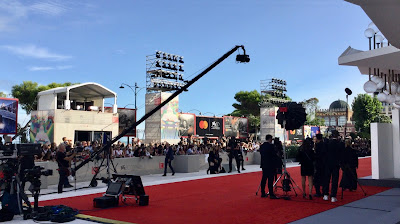 |
The Red Carpet behind the scenes - Photo: Cat Bauer
|
I had the chance to see 20 films this year, along with a bunch of
Virtual Reality and other Immersive projects. Here is my annual quick recap of
the films I managed to see, with letter grades and links to reviews that
I agree with the most.
1. Comandante
Instead of Luca Guadagnino’s Hollywood dazzler Challengers starring Zendaya kicking off the Venice Film Festival, which was pulled by MGM/Amazon due to the strike, the opening film was
Edoardo De Angelis’ Italian drama, Comandante. Set on an Italian submarine during World War II, it's based on the true story of Salvatore Todaro, played by Italian powerhouse Pierfrancesco Favino.
Todaro was born in Sicily, but grew up in Chioggia in Venice. As commander of the Italian Royal Naval submarine, Comandante Cappellini, Todaro blew up a Belgium ship carrying British war supplies and then, astonishingly, rescued the Belgium seamen.
I really enjoyed the film, but I think it's because I live in Italy -- I'm not sure it will translate well into the English-speaking world. There were lots of Venetian expressions, as well as colloquialisms from the rest of Italy -- in fact, Todaro writes to his wife about how the sailors on the sub are united even though they speak different dialects and come from different Italian regions -- sort of like men from Alabama bonding with men from California.
I ran into Pierfrancesco Favino at the Excelsior Hotel on the Lido. I told him: "I'm an American who's lived here since 1998. I loved your performance and the film. I was rooting for the fascists!"
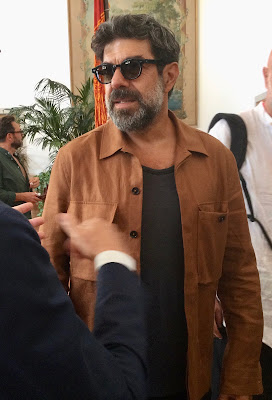 |
Pierfrancesco Favino
Photo: Cat Bauer
|
Here's a review from Catherine Bray at the
Guardian that I agree with:
Comandante review – fun, if you ignore the voice in your head telling you it’s wrong
...Surely Italy is that nice place with the gnocchi and olive oil? Hard to imagine they were … fascists?
...Todaro is presented as a man so noble he almost seems to misunderstand
how war is supposed to work. And perhaps he really was: rebuking a
German officer who finds Todaro’s “hate the game, not the player” policy
ludicrous, the man reportedly said: “I’m Italian, I have 2,000 years of
civilisation behind me.”
I don't know if Comandante will make it to US screens, but it's worth seeing, especially if you're of Italian heritage. Grade: B+
2. Dogman
Many critics lambasted Luc Besson's Dogman, which, to me, seemed like some kind of Me Too pile on to punish the French director, who has been cleared of all rape allegations against him. I liked the weird film starring Caleb Landry Jones about a cross-dressing loner in a wheelchair bruised by life and the many dogs that protect him.
Damon Wise from Deadline liked it, too:
Caleb Landry Jones Blows The Roof Off Luc Besson’s Boisterously Insane Action Thriller
Luc Besson’s Dogman
is a superhero movie in search of a comic book, which makes a
refreshing change amid the summer’s raft of DC disappointments. It skews
a little close to Todd Phillips’ Golden Lion winner Joker in terms of weirdness and (especially) wardrobe, but it also offers the perfect showcase for star Caleb Landry Jones, who imbues a boisterously insane action thriller with heart and soul in what must surely be a career-high performance.
Set in New Jersey, the film is in English, not French, and, as noted, is in a similar key to Joker. It's scheduled to be released in French cinemas on September 27 and October 5 in Italy, but I don't know about the States. See it if you can. Grade: B+
3. Ferrari
Michael Mann's Ferrari signed the interim SAG-AFTRA agreement, which allowed star Adam Driver to appear on the red carpet in Venice to promote the film. It was a very effective way to call attention to the purpose of the strike.
To support the actors, indie productions like Ferrari and Dogman have agreed to all the terms the SAG-AFTRA union is asking for. By having the movie star wattage of Adam Driver here in person, it made an impressive impact -- and illustrates that producers can agree to the demands of the union if they want to.
That said, though some critics loved it, to me, Ferrari was not Mann's strongest film.
Siddhant Adlakha at Mashable says:
...Where Mann's masterpieces like Heat feature a riveting sense of
atmosphere — there's always a thickness in the air, born of his use of
light, focus, and the interplay of characters and their environments — Ferrari
is more of a concert of still images that feel mildly pleasurable to
look at in isolation. However, while the simplicity of these images
yields a film that is, for the most part, lukewarm, they are also
complimented by a complex aesthetic flourish that rears its head from
time to time as a reminder of what the movie is truly about at its core...
Ferrari is scheduled to be released in the United States on Christmas, December 25, 2023. I wouldn't give up Christmas dinner to see it, but maybe catch it before the New Year. Grade: B-
4. Hollywoodgate
I agree most with Daniel Fienberg at the Hollywood Reporter.
Chronicle of the Taliban’s Return to Power Fascinates and Frustrates
Ibrahim Nash'at's documentary follows two Taliban officials through the first year after the American withdrawal from Kabul.
Maybe Nash’at hoped to get something more decisive, more instantly cautionary, but I suspect Hollywoodland (sic - should be Hollywoodgate) will
gain potency in the years to come. The Taliban wanted a 90-minute
commercial and Nash’at wanted 90 minutes of truth, and what they both
got was a portrait of the complicated cost of access — more vital in its
universal applicability to documentary filmmaking than its immediacy as
a documentary.
I couldn't find a release date for the U.S. Stream it if it pops up in the States. Grade: C
5. Finalmente l'alba (Finally Dawn)
I enjoyed this strange film by Italian writer-director Saverio Constanzo in both Italian and English set on one long day and night in Rome in the 1950s at the Cinecittà film studio when an innocent teenage girl who wants to be an extra instead becomes a kind of star. I especially liked Willem Dafoe as a charming art dealer who does a lot of translating between the characters. He can really speak Italian -- he's married to Italian actress Giada Colagrande, and they live in Rome, LA, and NYC.
From Peter Bradshaw at The Guardian:
Finally Dawn review – Lily James shines in exuberant romantic melodrama
James is the Liz Taylor-ish diva claiming a young star-struck girl as
her new best friend in Saverio Constanzo’s tale set in 1950s Rome
It is the tale of an unconventionally beautiful duckling who becomes
more of a swan than the glamorous people she idolises; her dreams come
true – or sort of true – in 1950s Rome in the heyday of the giant
Cinecittà film studio. There are seductive performances from Lily James
as the Liz Taylor-ish American movie diva, Willem Dafoe
as her elegant, kindly confidant, Rachel Sennott as the disaffected
up-and-coming actor who wants to unseat James’s star, and a lovely turn
from relative newcomer Rebecca Antonaci as the bewildered and unlikely
heroine.
I can't find a release date yet, but I'm sure it will at least stream eventually. Worth watching. Grade: B
 |
Emma Stone & Ramy Youssef in Poor Things
|
6. Poor ThingsAs I wrote previously, I loved Poor Things, along with nearly every critic. The film delivers its message of female empowerment with sheer joy, wit and creativity. I am thrilled that it won the Golden Lion, the top award of the Venice Film Festival (and that Willem Dafoe stars in this one, too).
Go out and see it in the theater when it opens on December 8, 2023 in the US, and on January 12, 2024 in the UK. It's better than Barbie. Grade: A+
7. The Palace
Roman Polanski's The Palace was despised by most critics, and in this case I think it has nothing to do with the Me Too movement. The movie is just bad.
Owen Gleiberman from Variety:
Roman Polanski’s New Year’s Eve Hotel Comedy About a Bunch of Wealthy Idiots Is a Laughless Debacle
Polanski and comedy have never jelled, and at 90 he works with a timing that's decades out of date.
Nothing in the movie is funny. Not the constant scrambling of
the hotel manager, Mr. Kompf (Oliver Masucci), to placate the overgrown
babies who are his guests. Not John Cleese overplaying the oil-tycoon
drawl and then going the way of “Weekend at Bernie’s” (apologies for the
spoiler — I hope I haven’t ruined the movie for you). Not the live
penguin who gets shipped to the hotel and keeps wandering around...
The Palace is set to be released on September 28 in Italy, but does not have a distributor in the US, UK, or France, so you probably won't be able to see it. Grade: D
8. Maestro
Because of the strike, Bradley Cooper was not in Venice to support Maestro, the film that he both starred in and directed, which focuses on the marriage of the bi-sexual Leonard Bernstein. Cooper had the full support of the real-life Bernstein family, with the composer's three children here at the world premiere.
From Fionnuala Halligan in Screen Daily:
Director/star Bradley Cooper conducts an impressively-mounted, if uneven, portrait of composer Leonard Bernstein
...Which is to say that Maestro plays like a more modern work: a
staccato piece. The black-and-white section at the start is the most
joyous, carefree and flowing; central parts, where the marriage starts
to fracture despite Felicia being happy to entertain her husband’s
lovers, are loud, veering towards abrasive; the final third, with
depression and illness, feels like a slow, painful thud to fade...
Maestro is scheduled for limited theatrical release in the U.S. on November 22, 2023, before streaming on Netflix on December 20, 2023. It might make a good night out if you're in NYC, but there is a Netflixy feel about it, so it's OK to stream. Grade: B+
9. La Bête (The Beast)
Due to my own stupidity, I missed the first half hour of La Bête, but I think it worked out OK because it is a non-linear film about past, present, and future lives, jumping through time, and switching from French to British and American English. Its running time is two hours and 26 minutes, so I caught most of it.
From Jordan Mintzer at The Hollywood Reporter:
Lea Seydoux and George MacKay in Bertrand Bonello’s Creepy, Conceptual Time-Tripping Saga
The
French director adapts a Henry James novella, which he transforms into a
romantic thriller set during three different epochs.
...Set simultaneously in 2044, 2014 and in the belle-époque Paris of 1910,
when the Seine overflowed and plunged parts of the city underwater, The Beast is at once an anxiety-ridden romantic thriller and a conceptual cri de coeur
about the possible end of humanity. It features incredibly lifelike
robots, exposed green screens, freaky ceramic dolls, and scenes of
Seydoux doing futuristic hot yoga and dancing to trap while high on
molly...
The Beast is set to be released in France on January 28, 2024. Will it be released in the U.S.? If so, it's worth streaming. Grade: B
10. The Killer
I think Michael Fassgender is terrific, so I was looking forward to The Killer, directed by David Fincher. It's slow-moving uber-violent Netflix about an uber-professional assassin with a narrative that Fassbender tells in a monotone voice-over.
From Owen Gleiberman at Variety:
David Fincher’s Hitman Thriller Is a Portrait of a Coldly Methodical Assassin Played by Michael Fassbender
It's all homicidal procedure: gripping at times, more conventional than Fincher thinks at others.
“The Killer” turns out to be a movie about waiting around to kill
people. Fassbender speaks in a low affectless drone, saying things like
“On Annie Oakley jobs, distance is the only advantage” or “No one who
can afford me needs to waste time winning me over to some cause” or
“Most people refuse to believe that the great beyond is anything more
than a cold, infinite void.” He sounds as dread-squeezed and controlled
as Martin Sheen in “Apocalypse Now” when he said, “Never get out of the
boat. Absolutely goddamn right.” Committing a hit may be mostly about
counting down the minutes and hours, but Fincher builds the sequence
with a veteran suspense filmmaker’s cunning.
The Killer will debut on Netflix on November 10. Grade: B+
 |
| Watching Woody Allen photo call in the press room |
11. Coup de Chance
Nobody in the United States would give Woody Allen money to make a movie, so he made one in French, a language he does not speak, set in Paris. During the press conference, he said that he always was better at writing parts for women.
And that's true. Think about it -- long before anyone else was writing decent female roles, Woody Allen created strong female protagonists. He has received the most nominations for the Academy Award for Best Original Screenplay, with 16.
Coup de Chance is a solid film, entertaining, with good performances. It takes a long buildup to reach the punchline, but when it arrives, it makes you laugh out loud.
From Xan Brooks of The Guardian:
Woody Allen’s tale of ill-fated lovers is his best film in a decade
An adulterous affair between bored millionaire’s wife Fanny and struggling writer Alain is surely bound for disaster
How Allen continues to conduct his career is obviously his business
alone. But if he were ever minded to collect his winnings and quit the
table, his 50th feature might be a decent film to go out on. Coup de
Chance is variously funny and sad, energetic and easygoing; a stumbling
but satisfying autumnal drama that wanders amid the fading light and the
golden leaves. For good measure, Allen even throws in an ending which
stirs the memory of the classic moose-hunting routine from his old 1960s
standup days; a rueful, airy aside that serves to bring the man’s
career full-circle.
Woody Allen will be 88 on November 30. Someone asked him if he would ever make another movie set in New York, and he said he would if someone else raised the money, the part of film making he does not enjoy.
I hope someone does help Woody raise the money to make at least one more film in English set in New York. Coup de Chance will be in theaters in France starting on September 27, 2023. It does not have a U.S. release date... yet. Grade: B
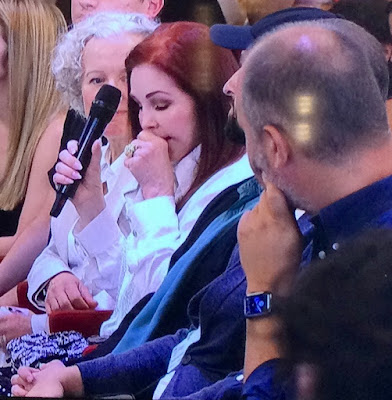 |
An emotional real-life Priscilla Presley at the Venice Film Festival
Photo: Cat Bauer,
(from a live press conference streamed into the press room)
|
12. Priscilla
I thought Priscilla was excellent. Cailee Spaeny, who starts off playing the 14-year-old Priscilla Beaulieu on a German military base, morphs into the adult wife of Elvis Presley living in Graceland. Her performance won Spaeny the Best Actress award at the Venice Film Festival.
From Stephanie Zakarek at Time:
Venice Review: Sofia Coppola's Priscilla Is Quietly Extraordinary
Have you ever had an
intense experience—fallen madly in love, say—only to look back years
later and feel it had happened to a different person, a person who had
walked through a dream, and survived it, to get to the self you were
destined to become? That’s the feeling Sofia Coppola captures in her
quietly extraordinary Priscilla, which is adapted from the story told by Priscilla Presley in her candid and moving 1985 memoir Elvis and Me.
The real-life Priscilla Presley was here in Venice at the press conference, though not up on the panel with the film entourage. Someone asked her a question, and she gave an emotional answer from the audience. "He was the love of my life. It was the lifestyle I left. We never left each other."
Priscilla opens in the US on October 27, 2023. Go see it. Grade: A-
 |
Seydou Sarr, director Matteo Garrone, Moustapha Fall at photo call for Io Capitano
|
13. Io Capitano (Me Captain)
I would translate Io Capitano to "I, Captain" instead of Me Captain. It is an extraordinary story of two innocent teenage boys from Senegal who dream of coming to Europe to become pop stars. They are not running away from war or extreme poverty. They just want the freedom to move to another country.
In order to arrive in Europe, these
two boys must make a harrowing, brutal, deadly journey through the Sahara Desert and
across the Mediterranean Sea. One boy ends up behind the helm of a rickety boat stuffed with 250 fellow migrants. It is based on true events.
From Leila Latiff at Indie Wire:
‘Io Capitano’ Review: Matteo Garrone’s Stunning Film Puts a Human Face on the Migrant Crisis
Venice: Garrone's film hinges on one of the most impressive and
transfixing acting debuts in recent memory, from breakout Seydou Sarr.
The film itself is inspired by real-life events, in which Garonne came
across a story about a 15-year-old boy who had no nautical or navigation
experience but was tasked by a people smuggler to take up the captain’s
mantle and steer a boat carrying 250 people across the Mediterranean.
But despite there being no shortage of hideous accounts of the journey
to Europe for desperate African refugees, Seydou and his accompanying
cousin have foolishly deep wells of optimism. Garonne uses their naivete
to ratchet up suspense, making each time they trust in the goodness of
their fellow man feel like watching an inebriated teenage girl in a
slasher movie enter a dark basement.
Io Capitano is the perfect Hero's Journey. Matteo Garrone won Best Director and Seydou Sarr won Best Young Actor. Right now,
Me Captain has no US distribution. When somebody figures out how to get the film in front of the eyes of English-speaking audiences, make every effort to see it.
Grade: A
UPDATE - September 24, 2023: Io Capitano was chosen by Italy as its candidate for Best International Film at the 96th Academy Awards, and is on the cusp of announcing a US deal, according to Deadline. 14. Origin
Again, I agree most with Leila Latiff at Indie Wire:
‘Origin’ Review: Ava DuVernay Links Historical Injustices Together in Sprawling Misfire
Venice: DuVernay's adaptation of Isabel Wilkerson's "Caste: The
Origins of Our Discontents" comes across as a misguided riff on the "Eat
Pray Love" formula.
The best thing that can be said about “Origin” — beyond the undeniable
fact that it’s competently made — is that it really does make you want
to read the book. Wilkerson research into the anthropological rot that
links enslavement and segregation in America to the plight of the Dalits
in India and the Holocaust is fascinating in the parallels it draws
between what could otherwise be regarded as disparate acts of societal
evil. But fails to offer sufficient nuance, speeding through to the
moment where she finally lays out the eight core “pillars” of the
argument without clear distinction. It seems an obvious criticism to say
that a nonfiction book would have been better suited for adaptation to a
documentary.
Neon will release Origin sometime in late 2023. Wait for it to stream. Grade: C
15. Hit Man
There is nothing earth-shattering about Hit Man. It's just fun and entertaining, and would make a good movie for a dinner and a date.
From Xan Brooks at The Guardian:
Richard Linklater mixes philosophy and fun in true-crime caper
The director shows off his quickfire, casual side with a yarn about a contract killer who isn’t all he seems
Richard
Linklater’s latest is a jaunty action comedy that spins its
machine-tooled high concept like a bicycle wheel – sometimes with shrewd
intent, sometimes for pure fun. Loosely based on a longform true-crime article
by Skip Hollandsworth, it follows the fortunes of Gary Johnson, a fake
contract killer for the New Orleans police department, setting up stings
in cheap diners while the cops wait outside. In the hands of a lesser
director, Hit Man would surely have felt rather thin and disposable. But
Linklater is a pro, and he manages to make the film’s fripperies feel
borderline profound.
It seems Hit Man will be released in the States on October 6. You can take a date to see it, or wait for it to stream. Grade: B
16. Holly
I really tried to find another critic besides Leila Latiff at Indie Wire who I agreed with about the Belgium film, Holly, but I couldn't. It seems Latiff and I have the same taste in films. Everyone else seemed to like Holly more than either of us.
From Leila Latiff at Indie Wire:
‘Holly’ Review: A New Twist on ‘Carrie’ Forgets Its Bloodiest Pleasures
Venice: Fien Troch's film pulls liberally from the Stephen King playbook, but is missing its catharsis and insight.
What’s most frustrating about “Holly” is its potential. No one is
suggesting that Troch’s film should offer a full exploration of a
teenage girl becoming the messiah (well, maybe, Ryan Murphy would see
this material and suggest that), but its strange for a film to commence
with the immolation of her peers and then spend the next 90 minutes
barely shifting those relationships.
Holly will be released on November 22, 2023 in Belgium. Do these movies ever pop up in the States with English subtitles on some streaming service? Grade: C
17. Paradise Is Burning
I really liked Paradise Is Burning, which screened in the Orizzonti (Horizons) section of the Venice Film Festival, and was not reviewed by the major critics. It's about three underage sisters growing up without a mother, who ran off and left them on their own.
First, to give you some context, here's the review from Rebecca Rosén at an indie publication called Flip Screen: ‘Paradise is Burning’ (2023) Is a Triumphant Love Letter to Sisterhood
"An equally beautiful and heartbreaking coming-of-age tale that delicately balances humour with pain”
Having a sibling is perfectly summed up in the act of telling a person
to go to hell and then worrying about them getting there safely—it’s an
intricate relationship filled with both frustration and love. Although
commonly portrayed, it isn’t always easy to authentically present these
connections simply due to their characteristic complexity. Paradise is Burning (original title: Paradiset brinner)
does it successfully though, as it finds the right balance between
conveying how strongly these sisters feel about each other and how much
they can end up hurting each other due to the very same reason.
For most of the movie, I couldn't figure out which Scandinavian country we were in until the sisters performed coming of age ceremonies, and I thought, it's got to be Sweden. No other country has such strange customs. For example, when the youngest sister's tooth falls out, instead of putting it under a pillow and getting cash from the tooth fairy, the older sisters have her swallow her it with a shot of liquor. And when the middle sister gets her period, all the girls in the 'hood get together while she gulps red wine and roars through her teeth like a wild beast.
It turned out the country was Sweden, but the rituals were complete fiction. In the Q&A after the screening, director Mika Gustafson said they invented the ceremonies to fit the sisters. I told her that she's going to have the rest of the world thinking that's what girls really do in Sweden!
Probably the only way you'll get to see the film is if it is nominated to be Sweden's candidate for Best International Film, which it very well could be. Grade: A-
18. Gasoline Rainbow
The kids are all right! I really enjoyed this movie. It seems the only thing that has changed in the 50 years since I graduated high school is more piercings and tattoos. Otherwise everything seems about the same, including the music.
From Leslie Felperin of The Hollywood Reporter:
‘Gasoline Rainbow’ Review: The Ross Brothers’ Teen Road Movie Is a Pleasurable Ride
The latest from Bill and Turner Ross is about a group of high-school friends who set out to see the Pacific.
...As with the Ross Brothers other films, it’s obvious there’s no written
dialogue for the performers to recite back, but there is more of a sense
of a guiding narrative trajectory here than in some of the other films.
All five kids are complete naturals on camera, and you would never
guess that they just met through the making of the film and didn’t know
each other for years. The way they respond to music collectively is
recognizably very Gen Z...
Mubi will release the film in 2024. If you're Gen Z or curious, get high and go see it. Grade: B+
19. The Red Suitcase
The Red Suitcase was in the Orizzonti (Horizons) section. I can't find a review. It's a co-production from Nepal and Sri Lanka.
Here's a brief article from Naman Ramachandran at Variety:
Venice Horizons Film ‘The Red Suitcase’ Unpacks Rare Nepal-Sri Lanka Partnership
In mystery tale “The Red Suitcase,” a pick-up truck driver leaves
Kathmandu airport for a two-day drive with a delivery arriving from
abroad to a remote mountain village. On the high road, a solitary figure
slowly makes his way, wheeling a small red suitcase toward the same
village....
“‘The Red Suitcase’ is a simple and honest film made with only local talent from South Asia.
It was too simple and honest for me. I don't know if you'll ever have the chance to see it, but it was a bit interesting to see the local scenery and learn some history.
Grade: C-
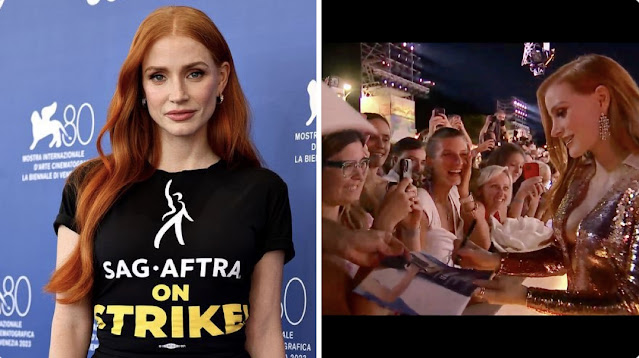 |
Jessica Chastain morphs from nervous at the presser
to glam movie star on the Red Carpet to promote Memory
|
20. Memory
At the press conference for Memory, a love story about a man with dementia and a single mother in AA, Jessica Chastain said she was nervous about coming to the Venice Film Festival during the strike -- she wore a bold, black tee-shirt to support the cause. She said, “I am here because SAG-AFTRA has been explicitly clear that the way to
support the strike is to post on social media, walk the picket line and
to work and support interim agreement projects. It’s what
our national board, negotiating committee and our elected leadership has
asked us to do.”
“The independent producers, like the ones here, are
letting the AMPTP know that actors deserve fair compensation, that AI
protection should be implemented, and there should be sharing of
streaming revenues. I hope my being here today encourages other
independent producers, and encourages actors to show up and support our union members. Hopefully we will see an end to the
strike soon and hopefully AMPTP will go back to the table.”
From
Bilge Ebiri at Vulture:
Jessica Chastain and Peter Sarsgaard Are So Weirdly Right Together in Memory
...Luckily, we have these two actors, who when together feel like a
chemical reaction come to life. Her tension is transformed by his
pleasant pliancy, and vice-versa. Sylvia is burdened by a swirl of
memories — most of which we get only hints of — confronted by a man who
can’t remember increasingly vast stretches of his life. As their
relationship grows in tenderness, we pull for them, even as we sense
that something horrifying might be around the corner....
Later on in the evening on the red carpet Chastain morphed into a
golden, glamorous movie star, signing autographs and taking selfies.
Coming near the end of the Venice Film Festival, it was an incredibly
effective way to illustrate the riveting power of a Hollywood star, and
the singular value of real-life human actors. Movie stars appearing on the red
carpet at the world premieres of their
films and interacting with their fans is an essential element of the
Venice Film Festival.
Peter Sarsgaard won Best Actor, his wife, Maggie Gyllenhaal at his side. It does not seem that Memory, written and directed by Michel Franco, has a release date yet in the US Let's hope the strike settles soon so you can see it. Grade: B+
Ciao from Venezia,
Cat Bauer
Venetian Cat - The Venice Blog